Tag: 2020 Elections

  • HinduPACT Co-Sponsors 2020 Presidential Debate from Hindu Perspective

    HinduPACT Co-Sponsors 2020 Presidential Debate from Hindu Perspective

    HOUSTON: The political divide between Hindu supporters of US President Donald Trump and his Democratic challenger Joe Biden is getting deeper with the presidential election less than two weeks away and the starting of early polls in some states. 

    In a sign of the growing political prominence of Hindus in America, the Trump and Biden campaigns are wooing this religious minority community like never before. Hinduism is the fourth largest faith in the US, representing approximately one per cent of the US population in 2016. 
    The Biden campaign in September launched ‘Hindu Americans for Biden’ in September, while the Trump campaign in August announced the formation of the ‘Hindu Voices for Trump’ as part of their efforts to attract the over two million members of the religious community in the US. 
    A virtual debate held on Sunday between American Hindu supporters of Trump and Biden brought the message home that there is a clear political divide among the community in the US. 

    While one group alleged that Biden “panders to Muslims”, the other accused Trump of being a “racist”. 

    The webinar titled ‘2020 Presidential Election: A debate on the American Hindu issues’ was co-sponsored by the Hindu American Foundation, the Hindu American PAC, the HinduPACT and the HinduVote. 

    During the debate, Biden supporters alluded to the Obama-Biden administration’s lifting of nuclear sanctions against India as a demonstration of Biden’s pro-India stance, while Trump supporters brought to light how Biden as the senate foreign relations committee chair passed a bill pumping billions of dollars for improving Pakistan’s economy, which ended up funding the Pakistan military and promoting terrorism across the border. 

    Trump supporters underlined that Pakistan honoured Biden with ‘Hilal-i-Pakistan’, the country’s second-highest civil award. On the other hand, Trump, they said, named Pakistan a ‘country of particular concern’ for supporting cross-border terrorism and drastically cut the financial aid to the nation. They recalled that Hindus had asked the Obama administration to cut aid to Pakistan, but it was not done. 

    A much more direct question to the Biden team was about the party platform having sections on American Muslims, American Jewish, but “nothing clear cut about American Hindu community, not even a mention”. 
    In response, the Biden team said the Democratic Party as a policy recognises “cultural communities” and not religious communities, thus, its policy towards “Indian American community” is on the platform. 
    Utsav Chakrabarty, a Trump supporter, said he had written at least six letters to the Democratic Party leadership, asking them to post a policy paper on American Hindus, but he never got any response. A Democratic Party operative, he claimed, told him that unless he made a contribution to the Biden campaign, nothing would change. 

    Tushar Dayagude, another Trump supporter, echoed Chakrabarty’s assertion that campaign contribution was a must for Hindus to have their cause recognised in the Biden team. 

    Dayagude opined that Hindu members contributing to Trump’s campaign was the reason Biden campaign ignored the community. 

    In this context, Srilekha Palle, a Trump supporter from Fairfox, Virginia, disputed the assertion that American Hindus largely donated only to the Trump campaign. Palle pointed out that a prominent Houston-based American Hindu raised USD 3.5 million from the community members in single night for Biden campaign. 

    Trump supporters said the Democrats have always “pandered to Muslims” and its support to the Hindu community was nothing more than a “tokenism”. 

    To drive home their point, they cited the Diwali celebration at the White House in 2012 when Obama was the president. The supporters pointed out that the Democrats invited the Islamic Society of North America as one of the sponsors of the event and provided a platform to its spokesperson to speak at the Hindu religious festival. 

    Buttressing the point further, Trump supporters showed on the screen an “insensitive” image tweeted by Meena Harris, niece of Democratic vice presidential nominee Kamala Harris. The tweet has now been deleted by Meena, 35, who is a lawyer and a children’s book author. 

    Meena had tweeted the image to greet Hindus on the ongoing festival of ‘Navratri’, which celebrates women power and the triumph of good over evil. In the image, Kamala Harris, depicted as goddess Durga, was seen killing President Trump, who was depicted as buffalo demon ‘Mahishasura’. The image also showed Biden as a lion, the ‘vahana’ (vehicle) of the goddess. 

    Chakrabarty said the only outreach the Biden team has made to Hindus is this kind of “tokenism, which at best is cheap and hurtful and at its worst, creates Hindu phobia”. 

    The Trump team at the debate also included Jay Kansara, a former director of governmental relations for the Hindu American Foundation in Washington DC, who played a key role in the Howdy Modi summit last year. 

    The Biden team panelists were Nish Acharya, who was Director of Innovation & Entrepreneurship in the Obama administration; and Niki Shah, a Hindu community organiser who worked closely on Hindu initiatives for former president Obama’s faith-based council. 
    Asked why the Trump campaign did not respond to a questionnaire sent by the Hindu American Foundation PAC, while the Biden campaign did, Kansara said he found the questionnaire heavily biased against Trump and, therefore, advised the Trump campaign against responding to it.

  • HinduPACT Co-Sponsors 2020 Presidential Debate from Hindu Perspective

    HinduPACT Co-Sponsors 2020 Presidential Debate from Hindu Perspective

    San Francisco, CA (Sunday, October 18, 2020): A coalition of Hindu American organizations joined hands to conduct a first of its kind debate to discuss issues relevant to the Hindu American community in the upcoming presidential election. On Sunday, October 18, 2020, six Hindu Americans, split evenly between the two presidential candidates, met virtually to debate topics as they related to the Hindu American community in the following three broad areas: domestic policy, foreign policy, and overall party stance. For each of the three areas, the debaters presented positions favoring their candidate as well as opposing the other candidate.

    The debaters, all of whom had demonstrated a commitment to the Hindu American community through their activism or spirit, were vocal supporters of the candidate they were representing. The debaters for the Trump side were Jay Kansara, Srilekha Reddy Palle, and Utsav Chakrabarti. The debaters for the Biden side were Nish Acharya, Tushar Dhayagude, and Niki Shah.

    In an active and, at times, very passionate debate, the debaters discussed, among many others, sub-topics such as the interactions and commitment of each candidate to the Hindu American community, President Trump’s presence at the Howdy Modi event last September, the Hilal-i-Pakistan award presented to Candidate Biden by the Pakistani government, and the commitment of each candidate to helping Hindu and Sikh persecuted minorities in Afghanistan.

    Jay Kansara, who served for nine years as Director of Government Relations at the Hindu American Foundation, spoke in depth about his experience of working with the Trump administration to foster a closer working relationship between the Trump administration and the Hindu American community. “I must say that the Trump administration is far more inclusive of Hindu thought or Hindu perspectives than the alternate, than the Obama-Biden ever was,” said Mr. Kansara.

    The other two debaters to represent the Trump side were Srilekha Reddy Palle, the Political Director for the American Hindu Coalition and an active leader in the Trump campaign and in the Republican party, and Utsav Chakrabarti, an active contributor to lawmakers on Capitol Hill and to representatives of the Human Rights Commission at the United Nation.

    Nish Acharya, who was appointed by President Obama to be a Senior Advisor to the US Secretary of Commerce and Director of Innovation and Entrepreneurship and is currently a Senior Fellow with the Center for American Progress, spoke about the similarities between the Democratic party in the US and the Bharatiya Janata Party’s platform in India. “The reality is, I would like to point out, that the BJP agenda in India actually is fairly progressive, in line with the Democratic Party. So when you look at some of Prime Minister Modi’s biggest agenda items…these are all efforts to progressively, economically, and socially empower Indians from the bottom everywhere and connect them to society so they have a chance for success and survival…That is an agenda of progressive economics that we all see on the Biden side,” said Mr. Acharya when questioned about the past relationship between the then Senator Biden and Pakistan as well as the excess foreign aid given to Pakistan under the Obama-Biden administration.

    The other two debaters for the Biden side were Niki Shah, a member of the Hindu Americans for Biden and a National Co Chair for South Asians for Biden, and Tushar Dhayagude, an active contributor to the political process by writing opinions and rebuttals.

    The debate was moderated by Rakhi Israni, an entrepreneur living in the San Francisco Bay Area. The event was sponsored by the Hindu American Foundation (HAF), the Hindu American Political Action Committee (HAPAC), HinduPACT, HinduVote, and the Coalition of Hindus in North America (CoHNA).

  • HinduPACT Quoted in Sri Lanka Express

    HinduPACT Quoted in Sri Lanka Express

    No place for Buddhists with Joe Biden’s identity politics?

    OPINION
    By Hassina Leelarathna
    https://www.srilankaexpress.org/dncbuddhist
     
    Comments are welcome.  Please write to hassinal@gmail.com
    August 23, 2020
     
    The run-up to the U.S. 2020 election is in full swing and so is the game of identity politics.
     
    While Donald Trump and the far right might seem like masters at it, Democrats are not far behind as they woo targeted racial and religious populations.  In the process, they’re raising hackles in traditionally Democratic-leaning ethnic communities.
     
    Buddhists are ignored by the right and taken for granted, even cold shouldered, by the left.  Some Sikhs and Hindus have their own grievances and are veering right.
     
    Take some of the remarks made by Democratic presidential candidate Joe Biden in his address to the Million Muslim Votes Summit last month:
     
    “As Hindu American advocacy organization, we at HinduPACT USA believe that just as Vice President Biden has created a special page for Islam and other faiths on his website, he should create a special section for other faiths.  So far, he has ignored this demand from the dharmic traditions, which include Hindus, Buddhist, Sikhs and Jains,” says Ajay Shah, Executive VP of the World Hindu Council of America.
     
    Shah sees Biden’s reference to teaching Islam and confessional faiths in schools as troubling as it excludes dharmic faiths.
     
    “If Vice President Biden wants to be the President of all Americans, he should first try to become a presidential candidate who includes all Americans and not pander to any particular faith community. We eagerly look forward to Vice President Biden’s campaign becoming more inclusive towards dharmic traditions.” 
     

    Turn now to the Democratic National Convention (DNC).  If it’s any consolation to Ajay Shah and others sharing a Hindu American advocacy platform, the virtually-run event last week featured Hindu and Sikh representatives.  However, it was at an interfaith service on Sunday, a day before the start of the convention (that ran  Aug 17- 20).

     
    Neelima Gonuguntla, an attorney from Texas recited the Shanti Mantra from the Vedas.  Sikh and interfaith community leader  Pardeep Kaleka of Wisconsin prayed for those who lost their lives and those who are all sick from the pandemic, and called for a more just and compassionate world. 
     
    Imam Noman Hussain of Milwaukee, Wisconsin, an  Islamic Studies Instructor and founder & CEO of an Islamic school, offered Muslim prayers.
     
    Other faith community leaders at the event:
     
    • Rex Lee Jim –  of the Diné (Navajo) tribe, a former Vice President of the Navajo Nation
    • Marin Webster Denning – Milwaukee, Wisconsin: member of the Oneida Nation of Wisconsin
    • Bishop William Murphy III – Atlanta, Georgia: Lead Pastor of The dReam Center Church of Atlanta
    • Bishop Samuel Green – Columbia, South Carolina:  African Methodist Episcopal Church
     
    In addition, there were confessional- faith blessings throughout the week of the convention.  On Thursday, the final day, as the Washington Post framed it, “Reflecting Democrats’ interest in interfaith engagement” four faith leaders from three religious traditions were featured:
     
    • Rabbi Lauren Berkun, vice president of the Shalom Hartman Institute of North America.
    • Sister Simone Campbell, executive director of the advocacy group NETWORK Lobby for Catholic Social Justice
    • Rev. James Martin, a Jesuit priest and editor at large of the Jesuit magazine America;
    •  Imam Al-Hajj Talib ’Abdur-Rashid, a Muslim social justice activist who leads the New York-based Mosque of Islamic Brotherhood.
    Biden’s unspoken message to Buddhists during the weeklong pageant celebrating the nation’s “collective strength and diversity:” blessings not needed. 
     
    Given an estimated 4 million American Buddhists, about 66 percent of whom lean liberal and vote Democratic, the snub is quite noteworthy, eliciting the following responses.
     
    “If they [Democratic National Convention] had only one prayer, I think it appropriate that they asked a Christian minister to recite the prayer, since Christianity is the majority religion of the country, and the minister’s short prayer was not especially sectarian, apart from the mention of “the matchless name of Jesus” at the end. But if they had a variety of clergy, they should certainly have included a Buddhist representative,” said Ven. Bhikku Bodhi, well-known American (Theravada) scholar-monk in response to my request for his views
     
    Ven. Walpola Piyananda, Chief Incumbent of the Los Angeles Buddhist Vihara, who has a large following of American Buddhist practitioners said it was “troubling that Buddhists are continuously overlooked by American political leaders.” 
     
    As an example, Ven. Piyananda points out that  The Hindu Diwali festival is celebrated both at the White House and the State Department, so is the Muslim Ramadan festival,” adding that it’s the right thing to do to make ethnic minorities feel welcome.  He has been trying for a long time without success to have Washington give Buddhists the same nod.  “I have written several letters on the subject, including to Sec. of State John Kerry.  Never received a response.”
     
    However, Ven. Piyananda is not giving up.  “Going forward, Buddhists must unite and make our voices heard.  Doing nothing is not an option.” 
     
    Mark Zuckerman of San Francisco, who describes himself as a “life-long Democrat and engaged meditator, a skill learned at Buddhist Temples,” noted the DNC’s “loud silence of faith leaders who speak to the American experience out of a Buddhist perspective.”  While his primary faith background is Jewish,  Zuckerman says his exposure to Buddhism has enriched him with “a message that blends beautifully into the community of beliefs contributing to the enhancement of our national motto: one from many, E Pluribus Unum.”
     
    With its emphasis on peaceful and nonviolent behaviors, he sees Buddhism as a positive force in crucial policy areas such as climate change. “The Democratic Party should overtly recognize these communities of faith and urge them to join in at this critical time in American history.”
     
    Ideally, Democrats should have refused to play that game of faith-based identity politics and simply assured us of a just society that respects and treats all people alike, with sound policy decisions backing up that promise. 
     
    With its decision to open and close its signature event with prayers of confessional faiths, with no representation at all of the Buddhist religion, the Democratic Party has indicated which religions are more welcome, whose votes more important. 
     
    It has also shown that they don’t practice in America what they preach to the rest of the world. 
  • HinduPACT Quoted in  India Today

    HinduPACT Quoted in India Today

    Indian-Americans not happy with Kamala Harris as Democrats VP pick

    Born to a Jamaican father and an Indian mother, California Senator Harris, if elected, would be the first woman vice president ever for the country.

    Kamala Harris” selection as the Democratic vice-presidential candidate has evoked mixed reactions from the influential Indian-Americans, with a majority of them expressing unfavourable opinions about the Indian-American senator”s track record and her stance towards India and the community.

    Democratic presidential candidate Joe Biden scripted history on Wednesday by selecting 55-year-old Harris, an Indian-American and an African-American, as his running mate in the election on November 3.

    Born to a Jamaican father and an Indian mother, California Senator Harris, if elected, would be the first woman vice president ever for the country.

    While her nomination has filled many aspiring women, particularly young women of colour, with joy across the globe, Harris” selection has also generated mixed reactions from about 3.9 million Indian-Americans, both Republicans and indecisive voters, who believe she lacks understanding of what she stands for and does not consider herself as a woman of Indian origin.

    After talking to various Indian-American groups, they all seem proud but have doubts at large on her handling of various critical issues towards the community and India.

    Radha Dixit, the founding member of Indo-American Conservatives of Texas, said, “The Democratic Party’s reliance on ”Identity politics” has undermined her campaign because the focus has shifted to her being Indian, Asian, Jamaican, African-American and a woman of colour. Divisions in these communities are now coming to surface. Nowhere did Kamala try to claim her Hindu or Indian heritage but people are thrusting their values on her”.

    “If the Democratic Party platform and Kamala Harris”s position on policy issues are the basis for deciding this election as it should be, no conservatives, men or women, will support this ticket,” Dixit said.

    Padma Shri awardee Subhash Kak, Regents Professor Emeritus at the prestigious Oklahoma State University is pleased with Harris” selection but is not happy with her political affiliation.

    “But I’m disappointed with her political positions that are not India-friendly and are far to the left on the political spectrum. In this, she appears to be consistent with Joe Biden who has adopted an agenda that does not acknowledge the need for a special relationship between the United States and India,” Kak said.

    Aditya Satsangi, founder Americans4Hindus, a SuperPAC organisation that represents the interests of Hindus, strongly believes that Harris is a major deception planned by the Democrats to divide the Indian-American votes.

    “She has always claimed to be of African descent rather than Indian and her record as an attorney in California is highly questionable. She has in fact promoted corruption in California,” Satsangi said.

    Founder of the ”Living Planet Foundation” Kusum Vyas considers Harris” nomination as refreshing but questions her track record.

    “She has solid credentials, but do we need to support a person who is a known critic of India”s Kashmir policy and has a strong leaning towards Pakistan. She has recommended abolishing the legal immigration process and supports illegal immigration which hurts people from countries like India, who come here legally,” Vyas said.

    “Harris is a supporter of the anti-India, anti-Hindu brigade, who calls herself Black, hates Indian side of her family, never recognised herself as an Indian,” said Radhika Sud from Atlanta.

    She is unaware of the atrocities of Kashmiri Hindus and has aligned with Pakistan. Indian-Americans won”t vote for pro-Pak, pro-China Harris, just because her mother happens to be an Indian, she said.

    “I would evaluate her on her past policies towards American Hindus and her future approach towards the community. On the first account, I do not see her having given any significant contribution. As for the future posture of the Biden campaign, I am concerned about the public bias they have shown against the American Hindu minority with their policy pronouncements,” said Utsav Chakrabarti, Executive Director HInduPACT.

    Rajiv Verma, a Houston community activist, believes that with Harris as Vice President, the Biden campaign has willfully forfeited any hopes to get the Indian-American votes as she opposes both removal of Article 370 and passage of the new citizenship amendment act by the Indian parliament.

    “Harris” uninformed comments on Kashmir are interference in another sovereign country”s internal matter and are setting up a dangerous precedent for American politics. The fact that the Democrats have shown no understanding of why India has taken the steps it has, makes me think they are purposely being obtuse. How is implementing the Constitution of a sovereign nation across the country discriminatory?” asks Professor Amulya Gurtu of Green Bay, California.

    “Harris needs to brush up her knowledge of Indo-US relations, failing which the votes of admiring Indian-Americans are not likely to translate into votes for the blue ticket. The present Indo-US relations with Modi-Trump chemistry is at its peak since centuries and Indo-American voters are happy with that,” said Subhash Razdan, Chairman and Co-Founder of Gandhi Foundation USA, in Atlanta.

    “My decision not to support Kamala has nothing whatsoever to do with whether she identifies as Indian or Black. It”s about all the Democrats, including her & Biden, toeing the line for vile Kashmiri terrorists in my ancestral homeland of Kashmir,” said Dr Vasudev Patel, president Federation of Indian-American Association.
  • Utsav Chakrabarty presents HinduPACT View to Americans4Hindus

    Utsav Chakrabarty presents HinduPACT View to Americans4Hindus

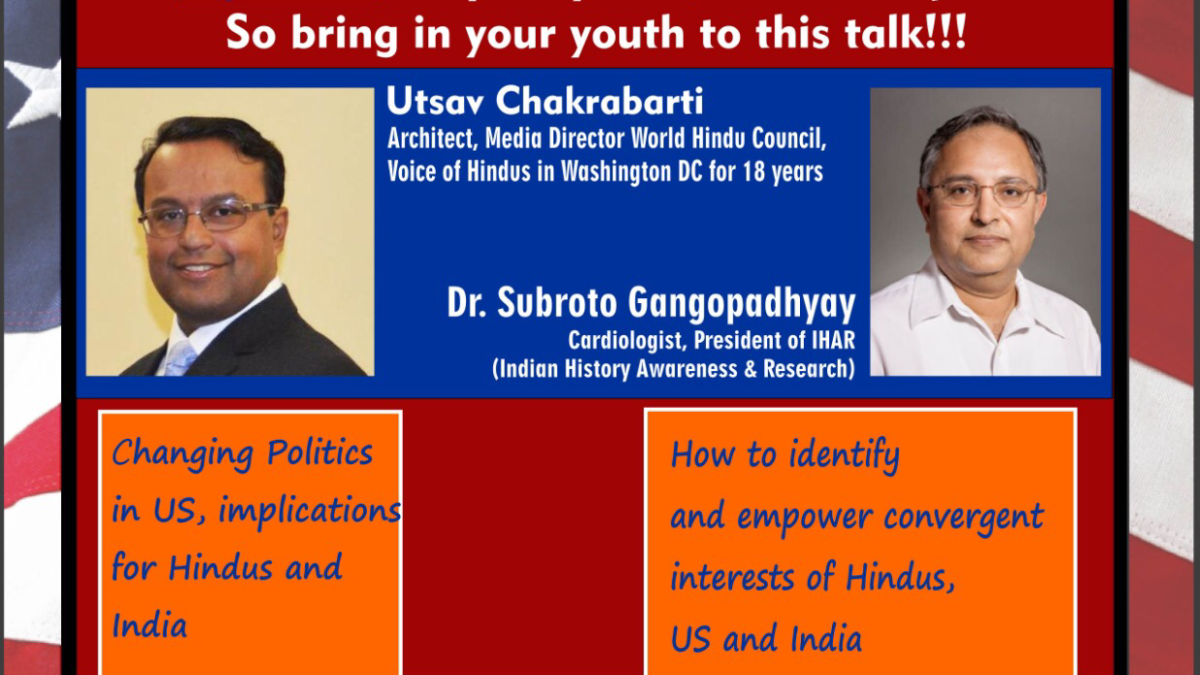
    Utsav Chakrabarty, Executive Director of HinduPACT presented a talk on, “Changing Politics in US, Implications for Hindus and Indian – How to Identify and Empower Convergent Interests of Hindus, US and India,” to Americans4Hindus

  • What Hindus Want from their Presidential Candidates

    What Hindus Want from their Presidential Candidates

    There are more than 4 million American Hindus in the United States. While most of them are of Indian origin, there are many who come from Bangladeshi, European, African-American and Nepalese heritage. This article examines the concerns and hopes of the American Hindu communities and the expectations they have from the Presidential candidates. It also examines the intra-community dynamics, based on my interaction with a cross-section of thought-leaders within the community

    Hindus have made immeasurable contributions to American society for generations. These contributions began at an early stage of America’s advancement as a global superpower, from Henry David Thoreau’s commentary on civil disobedience at Walden Pond, Massachusetts, that were informed by the teachings of sacred Hindu text of the Bhagavad Gita. Over the decades, the community has emerged as the most highly educated religious group in the U.S. 36% of American Hindus have income of $100,000*, 2nd highest of any religious community in the country. With more than 4 million voters, the community will go into the upcoming 2020 Presidential elections with the largest increase in registered voters among Asian Americans, since 2018.

    But all is not honky dory with the community when it comes to those that represent its aspirations and concerns, across the political spectrum. Despite their rapidly growing influence and strength in numbers, the American Hindu leadership is increasingly being marginalized by Geo-political forces, that are operating within the American political mainstream. These forces seek to fragment the American Hindu into intersectionalities of sub-identities and seek to turn current & future generations of voters into ‘useful idiots’ for causes that, at best, do not address the issues and demands of the American Hindus, and in their worst form, can be a threat to the Hindus themselves.

    Two such sub-identities are, the “South Asian” and the “Asian American Pacific Islander” identity. Both are geographical identities that will be of little consequence to future generations of Hindus born in the US. While the former is driven by pan-Islamism that seeks the erasure of Hindus themselves, and the latter is too focused on Sino-Asia Pacific geopolitics, to address many of the issues that are unique to Hindus in the US.

    With these concerns in mind, I spoke to leaders of the community over the past two months. While many of them agreed with me, some suggested that it was not the opportune time to raise these issues. The best response some could come up with, was that they were working hard “to address the Indian American issues”. Of course, few could understand the part that the “Indian American identity” itself has strategically been digested inside the “South Asian” identity and it would be very hard to convince a politician to work with a slice, when he can have the entire cake and eat it too.

    That brings me to the purpose of this article. At a time when the American Hindu who was traditionally a Democrat, but rapidly moving towards the Republican Party, what is it that they want from their Presidential candidates?

    I decided to speak with a cross section of the community’s thought-leadership, in the most bipartisan manner I could. Ajay Shah, the convenor of HinduPACT, and myself, put together a questionnaire that the Presidential candidates can respond to.

    A. Hindu Issues in America

    1. As a President, will you protect Hindu American constitutional and civil rights;
      honor the contribution of Hindu American communities across America; and
      create a safe environment for their growth and prosperity.
    2. Will you ensure that the Homeland Security, Justice Department, and the FBI will work closely with the Hindu Mandirs (Temples) and other organizations to
      ensure that they are provided protection against hate crime and discrimination?
    3. Will you ensure that the Department of Education will consult practitioners of
      Hindu faith to develop guidelines for state agencies? Will you ensure that the textbooks and instructional materials that promote Hinduphobia and reflect misrepresentation of Hindu dharma (faith) in school textbooks are removed?
    4. Will you de-fund Universities and colleges that continue to institutionalize
      Hindupobic teachings?
    5. Will you include Hindu American participation in national prayer meetings at the White House, and include at least 2 Hindu festivals in the list of festivals celebrated at the White House?
    6. Will you Include Hindu American organizations in faith-based service initiatives and, in the dialog on interfaith, diversity and inclusion?

    Over 80% of high skilled immigrants who are eligible for Green Card are Hindus. What are your views on extended delays in Green Card processing times (often more than 20 years) for these legal immigrants?

    B. Global Hindu Issues

    1. Will you promote equal rights and security for Dharmic communities (Hindu,
      Sikh, Jain, Buddhist) in Afghanistan, Pakistan and Bangladesh? The United States has a long tradition of offering hope and safe haven to refugees and to those seeking asylum. Will you give persecuted followers of Dharmic faiths who are minorities in these countries, asylum under the “emergency refugee protection” program?
    2. Will you work to restore Temporary Protected Status for immigrants from Nepal living in the United States?
    3. How will you promote stronger relations with India and support India’s role in a new vision for the Indo-Pacific, to counter-terrorism and advance our shared security and economic interests in the region?

    The American Hindu may decide who wins in Michigan, Pennsylvania, North Carolina, Texas and Florida, in the upcoming Presidential elections. The list above, is just an outline for the Hindu voter in the United States, so they can communicate with their party of choice, directly. It is as much a questionnaire for the Presidential candidates, as it is a guideline for the community leaders who do outreach to political surrogates and raise funds for them. More importantly, it is a wakeup call to those leaders that have been sacrificing the Hindu American identity under the more transient geographical and ethnic branding. While it may have served their objectives in the short run, it will harm the growth potential of Hindu leaders in American politics in the long run. The harm to our interest and wellbeing will follow soon.

    *Pew Research survey

    I discuss more about this on HinduLounge, episode 13 for World Hindu Council of America’s, HinduPACT initiative

  • Tejal Shah Presents Hindu View to Trump Campaign

    Tejal Shah Presents Hindu View to Trump Campaign

    Tejal Shah, Jt. General Secretary, World Hindu Council of America (VHPA) represented HinduPACT at a Trump campaign event.  HinduPACT, as an initiative of VHPA, a non-profit organization, does not endorse political candidates, but presents Hindu issues to political candidates. 

    A similar presentation is being planned with the Biden campaign