Tag: India

  • Transnational Repression, Hindu Diaspora, and India

    Transnational Repression, Hindu Diaspora, and India

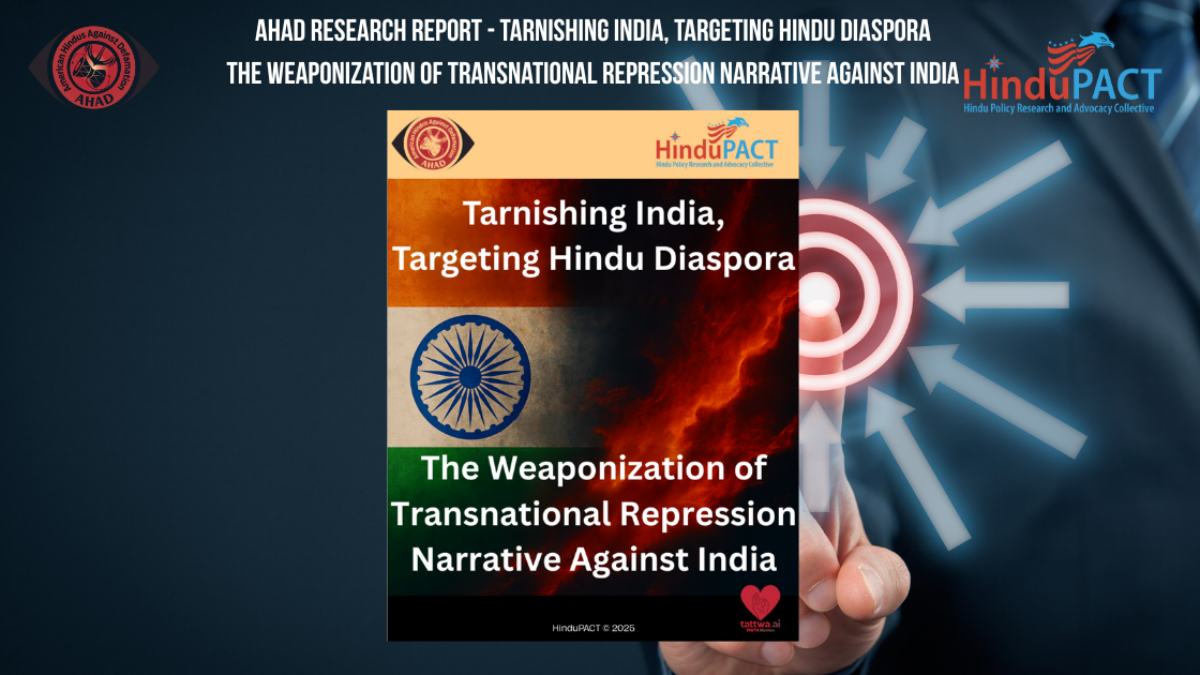
    Tarnishing India Targeting Diaspora Hindus

    The Weaponization of Transnational Repression Narrative Against India

    TNR Narrative – Tarnishing India Targeting Diaspora Hindus. A Report by AHAD an Initiative of HinduPACT

    TNR narrative against India is a product of coordinated advocacy, ideological bias, and geopolitical strategy, rather than empirical evidence. Its propagation threatens to undermine civil liberties, disrupt diaspora engagement, and erode the rights and cultural identity of Indian and Hindu communities abroad. The report calls for vigilance, transparency, and evidence-based policy to ensure that democratic values and diaspora rights are upheld, and that India and its diaspora are not unjustly equated with authoritarian regimes.

  • Debunking USCIRF 2025 Report – India and Religious Freedom

    (This report utilizes SamyaTattwa for Hindu News by American Hindus Against Defamation (AHAD), technology provided by tattwa.ai)

    Published March 27, 2025, 2025

    India and Religious Freedom: Debunking the USCIRF 2025 Annual Report

    The United States Commission on International Religious Freedom (USCIRF) recently released its 2025 Annual Report, painting a concerning picture of religious freedom in India. While the report aggressively labels India as a country of particular concern, a deeper and unbiased analysis presents a starkly different reality. It’s critical to address and rectify such narratives that overlook India’s intrinsic diversity, democratic values, and constitutional protections.

    Firstly, the USCIRF alleges deterioration of religious freedom driven by the Bharatiya Janata Party’s (BJP) “hateful rhetoric”. However, this assertion dismisses India’s strong constitutional framework that explicitly safeguards religious freedom under Article 25. India’s government, led by Prime Minister Narendra Modi, emphasizes national unity, security, and socio-economic development for all citizens irrespective of their religious affiliations. Numerous welfare programs introduced by the Modi government, such as the PM Awas Yojana, the Ujjwala Yojana, and the Ayushman Bharat health scheme, explicitly benefit minorities and economically weaker sections of society. The narrative that portrays the BJP as inherently anti-minority ignores the considerable socio-economic advancements achieved for all communities, including Muslims and Christians, under BJP governance.

    The USCIRF report also expresses fears regarding the Citizenship Amendment Act (CAA) and the National Register of Citizens (NRC). It claims these policies induce anxiety among Muslims about potential citizenship revocation. However, the CAA is explicitly designed to expedite citizenship for persecuted minorities from neighboring Islamic nations who have faced historical persecution. It does not impact Indian Muslims in any way. The NRC is simply a registry mechanism to identify illegal migration irrespective of religion. Unfortunately, misinformation has fueled unnecessary anxiety. Academic analyses, such as those by scholars like Agarwal (2020), have clarified these policies as measures addressing historical migration challenges and border security concerns rather than religious targeting.

    Another significant USCIRF claim highlights the construction of the Ram Temple in Ayodhya atop the ruins of the Babri Masjid as a demonstration of Hindu nationalism overpowering minority rights. The reality is profoundly different. The Supreme Court of India’s judgment on the Ayodhya case was the culmination of decades-long legal processes involving extensive historical and archaeological evidence. This landmark decision symbolized reconciliation, respecting the sentiments of both communities through legal avenues. Portraying this judicial resolution as religious discrimination grossly misrepresents India’s robust and independent judicial system.

    USCIRF further criticizes anti-conversion laws and laws prohibiting cow slaughter, branding them as mechanisms designed to target religious minorities, particularly Christians and Muslims. These laws aim solely to protect vulnerable communities from unethical conversion practices involving coercion or deception and reflect deep-rooted cultural and ecological ethics. India’s constitutional provisions explicitly prohibit forced conversions, and anti-conversion laws merely reinforce this principle. Similarly, cow protection laws are grounded in cultural reverence for cattle, integral to India’s agrarian communities. Instances of misuse, whenever identified, face strict judicial scrutiny, underscoring that such laws function within constitutional boundaries and are not anti-minority.

    The USCIRF report’s suggestion that India systematically employs hate speech and misinformation targeting minorities during electoral campaigns also deserves scrutiny. India’s vibrant democracy ensures robust electoral discourse. While political rhetoric can sometimes become intense, mechanisms like the Election Commission of India’s Model Code of Conduct enforce fairness and accountability, addressing violations impartially. The blanket portrayal of India’s political environment as inherently discriminatory is an oversimplification and ignores transparent enforcement measures.

    Accusations of transnational repression directed at Sikhs and other minorities abroad by the Indian government represent another contentious claim. Such allegations seem politically motivated and lack substantial evidence. The Indian diaspora, including Sikhs worldwide, actively and positively engage with India’s governance processes. India’s Ministry of External Affairs transparently addresses international concerns through diplomatic channels. Isolated diplomatic disputes should not be conflated with systemic repression.

    Moreover, the USCIRF critiques India’s use of laws like the Unlawful Activities Prevention Act (UAPA) and the Foreign Contribution Regulation Act (FCRA) as oppressive tools against minorities and civil society organizations. However, these laws primarily safeguard national security and integrity, ensuring transparency in foreign funding and preventing terror financing. India’s judiciary consistently scrutinizes their implementation, often providing relief to individuals wrongly accused. Such judicial interventions underscore India’s checks and balances system, disproving assertions of targeted discrimination.

    The report’s recommendation to classify India as a “Country of Particular Concern” and apply targeted sanctions would significantly harm strategic bilateral relations and ignore India’s democratic stability and regional importance. Such measures would be disproportionate responses based on selective reporting, overlooking India’s extensive religious pluralism and democratic structures. Geopolitical analysts, including Panda (2023), emphasize the critical role India plays as a democratic ally in the Indo-Pacific, asserting that sanctions based on exaggerated claims would severely undermine mutual geopolitical interests.

    Lastly, USCIRF claims that vigilantism associated with cow protection systematically targets Muslims. While unfortunate incidents of violence by vigilantes have occurred, Indian authorities consistently prosecute offenders irrespective of religion. Leaders across political and social spectra have repeatedly condemned such violence, emphasizing that protecting cultural values must never lead to unlawful actions.

    Overall, the USCIRF’s portrayal of India as increasingly intolerant and discriminatory distorts reality and omits substantial evidence demonstrating India’s consistent and rigorous application of constitutional safeguards, cultural inclusivity, judicial oversight, and transparent governance. India remains a vibrant, pluralistic democracy where minorities thrive and actively participate in all societal facets. It’s crucial to counter misrepresentations to foster better international understanding, recognizing India’s multifaceted socio-cultural dynamics and its robust democratic framework that unequivocally upholds religious freedom for all citizens.

  • American Hindu Perspective on USCIRF’s 2025 Report

    (This report utilizes SamyaTattwa for Hindu News by American Hindus Against Defamation (AHAD), technology provided by tattwa.ai)

    Published March 26, 2025, 2025

    Debunking USCIRF’s 2025 India Report: A Hindu-Centric Counter-Narrative

    The 2025 Annual Report of the U.S. Commission on International Religious Freedom (USCIRF) once again recommends India for designation as a “Country of Particular Concern (CPC).” This characterization is based on allegations of systematic religious freedom violations and communal intolerance under the Narendra Modi-led Bharatiya Janata Party (BJP) government. However, a closer examination reveals the report to be ideologically biased, factually inconsistent, and strategically silent on critical Hindu concerns.

    1. Religious Freedom and India’s Pluralistic Core

    India’s Constitution enshrines religious freedom under Articles 25–28. Minorities in India are not only protected but flourish—evident in the robust presence of over 200 million Muslims and more than 30 million Christians. The USCIRF paints a distorted picture by ignoring India’s civilizational ethos grounded in mutual respect and pluralism. As Mahatma Gandhi stated, Hinduism is not dogmatic; it accepts multiple paths to truth. Hindu dharma encourages coexistence, not coercion​.

    Organizations like the Rashtriya Swayamsevak Sangh (RSS), often vilified in the West, work tirelessly through over 150,000 service projects across India. Far from being divisive, RSS promotes national unity, cultural pride, and community upliftment​.

    1. Misrepresentation of CAA and NRC

    The USCIRF condemns India’s Citizenship Amendment Act (CAA) and the National Register of Citizens (NRC), suggesting these laws target Muslims. This is misleading. The CAA offers refuge to persecuted non-Muslim minorities from Pakistan, Afghanistan, and Bangladesh—nations where Hindus, Sikhs, and Christians face existential threats. The law does not exclude Muslims from citizenship under normal processes; it merely corrects a historical and humanitarian imbalance.

    The NRC is a neutral citizenship documentation effort and not inherently communal. Its misrepresentation ignores the mass exodus and genocide of Hindus from Pakistan and Bangladesh—facts amply documented by human rights trackers and Indian national records.

    Moreover, opposition to CAA-NRC has been exploited by radical elements like the now-banned Popular Front of India (PFI), which used violent protests and misinformation campaigns to polarize society​.

    1. Ram Mandir and Historical Justice

    USCIRF’s accusation that the Ram Mandir in Ayodhya was built on a “razed mosque” is a deliberate whitewash of legal and historical facts. The Supreme Court of India, after an exhaustive evaluation, affirmed that a pre-existing non-Islamic structure lay beneath the Babri Masjid. Archaeological and textual evidence confirmed its Hindu origins​.

    The temple’s consecration was not mob action but a lawful and symbolic correction of historical injustice. The USCIRF’s framing is not only biased but also dismissive of centuries of Hindu cultural trauma inflicted through temple destruction under successive Islamic regimes.

    1. Anti-Conversion and Cow Protection Laws

    State-level laws prohibiting forced conversions or cow slaughter are not discriminatory but protective. Tribal and Dalit communities are often targeted by foreign-funded missionary organizations using coercive means to convert. These laws aim to preserve religious and cultural autonomy for vulnerable communities.

    Furthermore, cow protection is an emotional and economic issue for Hindus. Select vigilante acts are not government policy, and Hindu leaders have unequivocally condemned violence. USCIRF fails to mention this nuance while ignoring the aggressive proselytization and social disruption caused by evangelical groups​.

    1. FCRA and UAPA: Tools for National Security, Not Religious Targeting

    The report claims India misuses the Foreign Contribution Regulation Act (FCRA) and Unlawful Activities Prevention Act (UAPA) to harass minorities. In reality, these legal instruments target NGOs and individuals engaged in financial misconduct or links to terror outfits.

    Several NGOs—including those run by Christian and Islamist groups—have been found violating FCRA norms, diverting funds for conversion or seditious activity. UAPA has been instrumental in curbing Islamist terrorism and Maoist insurgencies, which have killed thousands of civilians and security personnel.

    Crackdowns on such groups are national security measures, not religious oppression. India, unlike authoritarian regimes, uses judicial processes and grants legal recourse to the accused.

    1. Transnational Allegations and Sikh Separatism

    The USCIRF criticizes India for allegedly targeting Sikh separatists abroad. These claims are speculative and politically charged. Khalistani extremism poses a global terror threat. Indian actions, if any, are in response to attacks on its diplomats and the promotion of secessionist violence. Labelling such countermeasures as repression whitewashes the violence perpetrated by these groups.

    1. Hate Speech and Vigilantism: A Misleading Narrative

    The report paints a bleak picture of India as a country riddled with hate crimes against minorities. However, most incidents cited are isolated and legally addressed. India’s judiciary and state governments have prosecuted both Hindu and Muslim offenders without fear or favor.

    Meanwhile, attacks on Hindus—such as temple desecrations in Kashmir and communal violence in West Bengal—are either omitted or downplayed. This one-sided portrayal further erodes the report’s credibility​.

    Conclusion: Ideological Blindness Disguised as Advocacy

    The 2025 USCIRF report relies on selective data, ideological narratives, and omissions to portray a Hindu-majority democracy as oppressive. Its framing of Hindutva as inherently fascistic dismisses the indigenous Hindu civilizational revival underway—a revival rooted in dharma, justice, and self-respect, not intolerance.

    India’s social challenges are real, but they must be evaluated in a balanced, context-rich framework—not through the lens of Abrahamic exceptionalism or geopolitical agendas. If USCIRF truly values religious freedom, it must shed its colonial mindset and engage with India’s complexity, rather than demonizing its Hindu identity.

  • HinduPACT Responds to US State Department and Ambassador Garcetti’s Criticisms of India’s Decision to Implement CAA

    HinduPACT Responds to US State Department and Ambassador Garcetti’s Criticisms of India’s Decision to Implement CAA

    The following press release was issued by HinduPACT (an initiative of VHPA) on comments by the US State Department and US Amb. Eric Garcetti on India’s decision to implement CAA.

    March 16, 2024

    Considering recent criticisms from the US State Department and the US Ambassador to India regarding implementing India’s Constitutional Amendment Act (CAA), Hindu Policy Research and Advocacy Collective (HinduPACT) reaffirms its unwavering support for the CAA.  The legislation provides expedited citizenship to persecuted Hindu, Christian, Sikh, Buddhist, Jain, and Parsi minorities from India’s neighboring countries.  It underscores India’s dedication to safeguarding individuals and families against religious persecution, resonating with global humanitarian principles.

    We are astonished that the US State Department and the US Ambassador to India, Eric Garcetti, are ignorant of similar US laws.  India’s CAA is modeled after the Lautenberg Amendment to the Jackson–Vanik amendment to the Trade Act of 1974.  Enacted on November 21, 1989, this amendment specifically provides refugee status in the United States for nationals from the Soviet Union and later the former Soviet Union, Ukraine, Estonia, Latvia, or Lithuania who are Jews, Evangelical Christians, Ukrainian Catholics or Ukrainian Orthodox; as well as nationals of Vietnam, Laos, or Cambodia; and Jews, Christians, Baha’i, and other religious minorities from Iran.  


    Ajay Shah, Founder and Co-Convenor of HinduPACT, said,


    CAA does not impact any citizen of India.  The characterization of this law as being non-secular is unfounded.  Hindu minority is discriminated against and decimated in India’s neighborhood.  As Americans, we are disappointed that instead of standing for American values and the human rights of the persecuted, our government has chosen to oppose this humanitarian effort. 

    Deepti Mahajan, Co-Convenor of HinduPACT, said,

    “It is shocking to see the lack of empathy towards the plight of little girls from Hindu, Sikh, and Christian minority communities in Pakistan.  According to the UN Human Rights Commission, BBC, and APPG reports, on average, 1000 girls a year, as little as ten years old, get abducted, converted, and become victims of sex slavery and forced marriages in Pakistan.  Instead of calling out the government of Pakistan for its complicity in this ongoing heartbreaking act, the State Department seeks to criticize the Government of India’s effort to help these innocent victims.”

  • ACT: Ask Your Senator to Reject Eric Garcetti’s Appointment as Ambassador to India

    ACT: Ask Your Senator to Reject Eric Garcetti’s Appointment as Ambassador to India

    \
  • Press Release: HinduPACT Launches Petition Asking Senate to Reject Nomination of Eric Garcetti as Ambassador to India

    Press Release: HinduPACT Launches Petition Asking Senate to Reject Nomination of Eric Garcetti as Ambassador to India

    March 14, 2023

    WASHINGTON, D.C – HinduPACT has launched a petition asking citizens to urge their Senators to vote against President Joe Biden’s nomination of Eric Garcetti as the next Ambassador to India. The petition highlights Garcetti’s poor understanding of India and the Indian subcontinent, as well as his undiplomatic, sanctimonious attitude that is likely to alienate the majority of Indians which he.

    During the confirmation hearings, Mayor Garcetti made it clear that he plans to bring up India’s Citizenship Amendment Act (CAA) as a “core” piece of engagement. The CAA grants expedited asylum to persecuted Hindu minorities, and Mayor Garcetti has claimed that it is a human rights violation that discriminates against other groups in India. His statements are not only untrue but also unwarranted interference in India’s internal affairs.

    The Quad member democracies like the US and India must unite to counter the expansionist China. Mayor Garcetti’s untruthful, sanctimonious, and undiplomatic attitude will not only harm persecuted Hindu minorities in India but also cause severe damage to US-India relations when it is needed the most. The petition calls on citizens to sign and urge their Senators to vote against Garcetti’s nomination as the next Ambassador to India.

    The petition is a collaborative effort of concerned citizens who believe that Mayor Garcetti’s nomination as the next Ambassador to India is not in the best interest of the US or India. It seeks to draw attention to the dangers of Garcetti’s appointment and encourage Senators to vote against it.

    The petition can be found here: https://hindupact.org/2023/03/14/reject-garcettis-as-ambassador-to-india/


  • Press Release: HinduPACT Calls on Congress to Reject Hinduphobic Resolution, Demands Ilhan Omar Cut Ties with Radical Islamist Groups and Ousted PM Imran Khan

    Press Release: HinduPACT Calls on Congress to Reject Hinduphobic Resolution, Demands Ilhan Omar Cut Ties with Radical Islamist Groups and Ousted PM Imran Khan

    Press Release: HinduPACT Calls on Congress to Reject Hinduphobic Resolution, Demands Ilhan Omar Cut Ties with Radical Islamist Groups and Ousted PM Imran Khan

    FOR IMMEDIATE RELEASE

    June 24, 2022

    WASHINGTON, D.C – HinduPACT calls on Republicans and Democrats in Congress to reject Rep. Ilhan Omar (D-MN)’s recently introduced resolution which unfairly and dishonestly condemns India’s human rights record and alleges “violations of international religious freedom.”

    “With House Resolution 1196, Congresswoman Ilhan Omar is clearly taking talking points from Jamaat-e-Islami and Muslim Brotherhood-linked groups, which is extremely troubling to see from an elected official who has sworn an oath of loyalty to the United States Constitution,” said HinduPACT Executive Director Utsav Chakrabarti.

    Ilhan Omar is a politically controversial Democratic Congresswoman from Minnesota, who has been called out internationally in the past for her anti-Semitic remarks. This is not the first time – nor will it be the last time – she shows her anti-Hindu and anti-Indian bias while revealing her ties to Pakistan. In April, Omar visited Pakistan-occupied Jammu and Kashmir (PoK) following a photo op with former Prime Minister Imran Khan.

    That same month, the United States Commission on International Religious Freedom (USCIRF) released a biased report which HinduPACT pointed out was outsourced to Islamist groups. Omar heavily references this biased report in her malicious resolution. HinduPACT Executive Director Utsav Chakrabarti noted in April that this year’s USCIRF report followed “a pattern of reports that have appeared in previous years. Based on publicly available information on topics like Citizen’s Amendment Act (CAA) and Kashmir, the USCIRF report is a ‘copy-and-paste’ of talking points peddled by an agglomeration of Islamist groups working with radical Islamist-linked group “Justice for All”, on whose platform USCIRF commissioners are known to appear regularly.

    Ajay Shah, President of World Hindu Council of America (VHPA) and Convenor of HinduPACT said, “It would be easy to dismiss Rep. Omar’s HR 1196 as being borne out of ignorance or political pandering. However, even to a casual observer of the geopolitical situation in the Indian subcontinent, it is clear that this resolution has much deeper sinister motives.”  He further stated, “Ms. Omar has taken her ideological cues from the US hating Pakistani regime of the former Prime Minister of Pakistan, Imran Khan. It raises questions as to whether Rep. Omar was coached by Imran Khan? We demand she cut ties with him.”

  • Watch: Recent Interview by Utsav Chakrabarti, HinduPACT on PGurus

    Watch: Recent Interview by Utsav Chakrabarti, HinduPACT on PGurus

  • Press Release: HinduPACT Calls Out Biden Administration’s Hypocritical Views on Religious Freedom

    Press Release: HinduPACT Calls Out Biden Administration’s Hypocritical Views on Religious Freedom

    Press Release: HinduPACT Calls Out Biden Administration’s Hypocritical Views on Religious Freedom

    FOR IMMEDIATE RELEASE

    June 4, 2022

    WASHINGTON, D.C – HinduPACT criticizes the 2021 Report on International Religious Freedom released by Secretary of State Anthony Blinken on Jun 2, 2022 for its hypocritical position on India.

    The views on International Religious Freedom expressed by the Biden Administration in the Report on International Religious Freedom disproportionately attacks India and turns a blind eye to the egregious religious rights violations being carried out by other countries in the region.

    India has a robust and independent judiciary and an independent media. It is very capable of addressing its human rights issues. The State Department should better focus its attention on causes and reasons for religious extremism in the region and look to history to help recognize the same dangerous patterns which are currently repeating themselves. 

    “It is unfortunate that Secretary Blinken did not mention the forced conversion of young girls from religious minority communities in Pakistan,” said HinduPACT Executive Director Utsav Chakrabarti. “We have provided the State Department with ample information and evidence regarding this.”

    On average, everyday three girls – many of them minors – are forcibly converted away from their faiths to Islam and often married to men who are far older than them.

    “The State Department must recognize that India has been defending its geographical and civilizational values from radicalized Islamists for generations,” said Utsav Chakrabarti. “It is one of the longest struggles in our world’s history. It is important that fellow democracies like the United States stand with its ally India as it deals with efforts by Taliban-like extremist organizations working to spread their tentacles within the country.”

    Ajay Shah, President of World Hindu Council of America and the Convenor of HinduPACT and American Hindus Against Defamation (AHAD) said,

    “Plurality and freedom to practice religion in any form is a fundamental tenet of Hindu dharma. Despite massive amounts of foreign money flowing into India for radicalization and conversion, India has retained its character as a multi-faith society true to its Hindu civilizational ethos. As with any country with over 1.4 billion people there are bound to be isolated incidents of unrest. These incidents should not be ascribed to the systemic shortcomings of the society or the government.”  He further stated that, “The mention of Indian American Muslim Council in the report is clearly meant for President Biden’s domestic vote bank in the upcoming mid-term elections and diminishes the credibility of the report.”