Category: Media

  • High court’s decision won’t end debate over student-led prayers

    AHAD on Supreme Court Ruling about School Sports Prayers:

    Originally Published in: Dallas Morning News
    By: Jeff Weiss
    Published On: 06/19/2000

    High court’s decision won’t end debate over student-led prayers

    DALLAS, Texas _ The girl who took the microphone at a small-town Texas football field for a pre-game prayer set off a broad national debate. On Monday, the Supreme Court ruling that declared her prayer unconstitutional was very specific.

    The court rejected the invocation delivered in Santa Fe _ sanctioned by a public school administration, selected by a majority of students and delivered in front of a crowd that included students who have to be there. But the relative narrowness of the ruling leaves plenty of room for many other kinds of student-initiated, student-led religious expression on public school campuses, said those on both sides of the issue.

    Even in Santa Fe, Monday’s decision doesn’t necessarily end the debate.

    “All I can tell you is they won’t have a prayer before the football game in Santa Fe set up with a student vote,” said Jay Sekulow, chief counsel for the American Center of Law and Justice and one of the lawyers who represented the school district. “Other than that, we’re still analyzing all of it.”

    Other districts with a history of prayer before games, such as Celina in the Dallas area, agreed to abide by the ruling.

    But other religious activities developed in accord with previous high court rulings should be unaffected, said David Overstreet, assistant director of field ministries for the National Network of Youth Ministries.

    His group promotes See You at the Pole, an annual morning prayer held at many public schools. Since the prayer happens before school starts and each observance is student-led, Monday’s ruling will have no effect, he said.

    Mark Briskman, regional director of the Anti-Defamation League, applauded the ruling but said some religious groups are confused about the impact.

    “Some people think prayer and God have been removed from the public schools, and that’s simply not true,” he said. “Any student has the absolute right to pray privately. The problem arises when it becomes organized and school-sanctioned.”

    The 1,100-student Celina school district in northern Collin County had continued a long tradition of public prayer at football games through last fall. That won’t be repeated this year, said Superintendent Ken Burks.

    “The board wanted to wait and see what the Supreme Court had decided and indicated they would abide by it no matter what the decision was,” he said.

    Most other local school districts already had discontinued student-led prayers at football games. But some said Monday’s ruling answered lingering questions about this issue.

    “We were already in compliance with this ruling,” said Karla Oliver, director of community relations for the Duncanville, Texas, school district. “But this seems very final.”

    Last year, Duncanville, like many districts, observed a moment of silence before football games.

    The Aledo district, west of Fort Worth, is in a legal battle centered on the district’s decision to edit a student’s graduation prayer. But the Supreme Court decision appears narrow and is not likely to affect this court case or the district’s practices, said Superintendent Don Daniel.

    The district allows only a welcome message before football games and has adhered to earlier court decisions regarding school prayer, Daniel said.

    Pre-game prayers aren’t an issue for many other districts, including Dallas and Richardson.

    Organizations lined up in support or opposition to the ruling. The Texas Association of School Boards, the National Clergy Council, the Council on American-Islamic Affairs and the Fellowship of Christian Athletes were among the groups that opposed the ruling. The National School Boards Association and the Religious Action Center of Reform Judaism were among the groups applauding the court’s decision.

    Texas Attorney General John Cornyn issued a statement expressing disappointment with the ruling.

    The reaction of non-Christians was mixed. Local Muslims feared that ruling would cause schools to do away with religious activities altogether.

    “Our concern is for Muslim students who would like to gather and pray privately in a room at school,” said Mohamed Elmougy, regional president of the Council on American-Islamic Relations.

    “That’s a lot different than prayer at a football game,” he said. “But we don’t know what impact the ruling will have on this.”

    A spokesman for the Baha’i Center of Dallas said Baha’is aren’t easily offended by prayers outside their tradition.

    “Baha’is believe that in reality all the religions are one,” Kambiz Rafraf said. “So a Baha’i would not be offended by a prayer to Jesus. We believe prayer is indispensable.”

    Hindu groups praised the ruling.

    “When prayer is imposed on people, like at a football game, it can lose its spiritual significance,” said Ajay Shah of San Diego, Calif., spokesman for American Hindus Against Defamation. “It’s a broader issue than just who you are praying to. We don’t think you should force prayer on anybody.”


  • US Baptists pray for ‘Satan’s Hindu slaves’

    AHAD Condemns Southern Baptist Diwali Booklet

    Publication: The Guardian
    Author: , Religious Affairs Editor
    Publication Date: Nov. 2, 1999

    US Baptists pray for ‘Satan’s Hindu slaves’

    Just weeks after outraging US Jewish leaders with a booklet aimed at converting Jews to Christianity, the country’s biggest Protestant denomination has done it again with a campaign to convert “900 million people lost in the hopeless darkness of Hinduism”.

    The latest campaign by the Southern Baptist Congregation’s international mission board is timed to coincide with the Hindu festival of Diwali, which begins today.

    There are concerns that it may further poison relations between Christians and Hindus in India during the Pope’s visit this week. Violence against Christians by Hindu extremists has increased this year, with the attackers justifying themselves by accusing missionaries of aggressive conversion tactics.

    The Southern Baptists’ new booklet can be downloaded from the internet, making it instantly available worldwide. Much of it is taken up with suggested prayers for worshippers at the Baptists’ 40,000 churches. One suggestion, referring to the Bhojpuri, a Hindu people in India: “Pray that Christians will risk persecution and even death in order to share the Gospel message with the Bhojpuri.”

    It describes Bombay as “a city of spiritual darkness. Eight out of every 10 people are Hindu, slaves bound by fear and tradition to false gods and goddesses.”

    Of Calcutta, the booklet says: “Satan has retained his hold on Calcutta through Kali and other gods and goddesses of Hinduism.”

    The international mission board is the largest US missionary organisation outside the Roman Catholic church, with more than 4,800 missionaries around the world.

    Mark Kelly, a spokesman for the board, said: “Nobody at this end was aware of the Pope’s visit months and months ago when this was planned. There’s no such thing as a good time to publish something like this because there are always tensions in India.”

    He denied that the Diwali booklet was hostile to Hindus. “To be held in Satan’s power is a different thing from being Satan’s ally,” he said. “There’s nothing in there which says that Hindus are in league with Satan. While we regret people taking offence at the way it’s worded, it does accurately describe what we see as the spiritual condition of people lost without Jesus.”

    The booklet has already provoked condemnation from the organisation American Hindus Against Defamation, which earlier this year successfully campaigned against what it saw as a blasphemous treatment of a Hindu theme in the Stanley Kubrick film Eyes Wide Shut.

  • Shloka In Orgy Scene To Go, But Hundreds of Prints of Eyes Wide Shut Will Still Retain It

    Shloka In Orgy Scene To Go, But Hundreds of Prints of Eyes Wide Shut Will Still Retain It


    Publication: Rediff

    URL: http://www.rediff.com/news/1999/sep/01us1.htm

    Date of Publication: 09/1999

    Author: R S Shankar

    Bowing to pressure by the American Hindus Against Defamation and its allies, Warner Bros agreed on Monday to delete from the soundtrack the Bhagvad Gita used in an orgy scene in Stanley Kubrick’s controversial film, Eyes Wide Shut. The movie, starring Tom Cruise and Nicole Kidman, explores the darker side of a marriage, and ends up supporting monogamy.

    Hailed by many leading critics as one of the finest films in recent years, it was slammed by other critics including the influential Pauline Kael who came out of retirement to drub it as ‘a piece of crap.’

    It ends its American run with a disappointing $ 56 million at the box-office. It is showing on about 400 screens, and in a week, it would lose about 300. The movie will briefly play in second-run movie houses.

    A spokesperson for Warner said the agreement reached with the Hindu groups does not affect the prints which are being used in cinemas in the countries where the film is in release.

    Over 1,500 prints used in America would not be touched, Warner said, adding that where ever the film is in release, the shloka will remain. For instance, the print unveiling at the prestigious Venice Film Festival’s opening night today will have the shloka. But the television and video versions of the film in all countries will not have the shloka, the spokesperson added. The movie will be aired on American television after about six months. It will be available on video a few weeks thereafter.

    Eyes Wide Shut is currently running in Japan, where it is a big hit, and has grossed over $ 10 million. It is expected to end up with an impressive $ 25 million gross. In Australia, where many moviegoers walked out during several screenings, it has earned a modest $ 4.5 million. A Warner spokesperson said the prints there will not be altered.

    In England, Germany, Italy and a dozen countries, however, the print will be shown without the shloka. The movie will be shown on more than 350 screens in England shortly. American-born Kubrick made England his home for more than two decades.

    “It is significant the decision to delete the shloka came on the eve of the British release and at the end of the American engagement,” said one Hindu activist. “Someone in England must have thought of the huge protests there when Salman Rushdie’s book The Satanic Verses was released. Surely, we were not going to do anything as foolish as that, but what the heck, we are glad that some sense has dawned on the producers at last.”

    Nancy Kirkpatrick, senior vice-president for publicity at Warner Bros, said Jan Harlan, the London-based executive producer of Eyes Wide Shut, was shocked to learn about the hurt experienced by Hindu groups. Harlan has repeatedly said there was any intention to slight or hurt anybody, she said.

    “Kubrick too never intended to offend Hindus,” Kirkpatrick said, after discussing the issue with Harlan and others associated with the movie which was shot completely in England. “He was offered a number of chants and he chose one without realizing its meaning.”

    Kubrick had the final cut say in the movie, but the director died soon after the film was completed and edited for release. A few days before the movie’s release, Warner digitally masked part of the orgy scene in America to avoid a rating problem. Some critics and Kubrick fans protested, but since the movie, which took a strong $ 30 million in the opening week, began slipping at the box-office with a 50 per cent decline each week, the protests went unheeded.

    Hindu groups had argued that if Warner could soften the impact of the orgy scenes, they could delete the shloka from the movie.

    “We gave them 13 days notice,” said Ajay Shah, convener of the AHAD. “We said there would be protests wherever the movie is going to be released and Warner Bros – or anyone for that matter — should not think they could get away offending Hindus across the world.”

  • Urgent Clarification Sought From Producers of “Xena”

    Urgent Clarification Sought From Producers of “Xena”

    AHAD Letter to the producers of the show:

    Urgent Clarification Sought From Producers of “Xena”

    American Hindus Against Defamation

    Representing several prominent Hindu organizations in N. America

    Sue May
    Pacific Renaissance Pictures Ltd.
    P. O. Box 90409
    Auckland, New Zealand

    Dear Ms. May

    It has been brought to our notice that an upcoming episode of Xena : The Warrior Princes titled, “The Way” will depict God Krishna, revered and worshiped by hundreds of millions of Hindus. We have also been made to understand that this fictionalized portrayal of Lord Krishna may not be appropriate or in good taste.

    I would like to express strong concerns about this episode on behalf of American Hindus Against Defamation (AHAD). AHAD is a forum representing several prominent Hindu organizations in North America. These constituents of AHAD represent a vast majority of a million strong Hindu community in North America. AHAD was at the forefront of protest against SONY Music for denigrating display of Lord Krishna on the cover of album “Nine Lives” by Aerosmith. Over 20,000 people from around the world signed the protest against SONY Music in less than a week and thousands of others wrote and faxed their protest to SONY which eventually led to the withdrawal of this album cover.

    We would like to find out more about the episode, “The Way”. If possible we would like to request that you send us a transcript or a preview copy of this show so that we can find out how this revered God has been portrayed in your show. We can assure you of the confidentiality of any material that is sent to us.

    We certainly hope that the Universal Studios does not intend to hurt the sentiments of a billion strong Hindu community around the world. However, there is a distinct possibility that the airing of a story offensive to Hindus will indeed permanently alienate the Hindu community not just towards this particular show but all the entertainment products that Universal Studios produces. After all, Hindus around the world can hardly be silent spectators while the God they worship so passionately is being denigrated.

    It is our clear intention to avoid any confrontations or controversies. We have always sought to amicably resolve the issues that hurt the Hindu sentiments in the very early stage, and we are indeed hopeful that this issue will also be similarly resolved.

    I look forward to hearing from you.

    Ajay Shah,
    American Hindus Against Defamation

  • Portrayal of Shree Krishna on Xena : The Warrior Princess Raises Concerns of Hindus Worldwide

    Portrayal of Shree Krishna on Xena : The Warrior Princess Raises Concerns of Hindus Worldwide

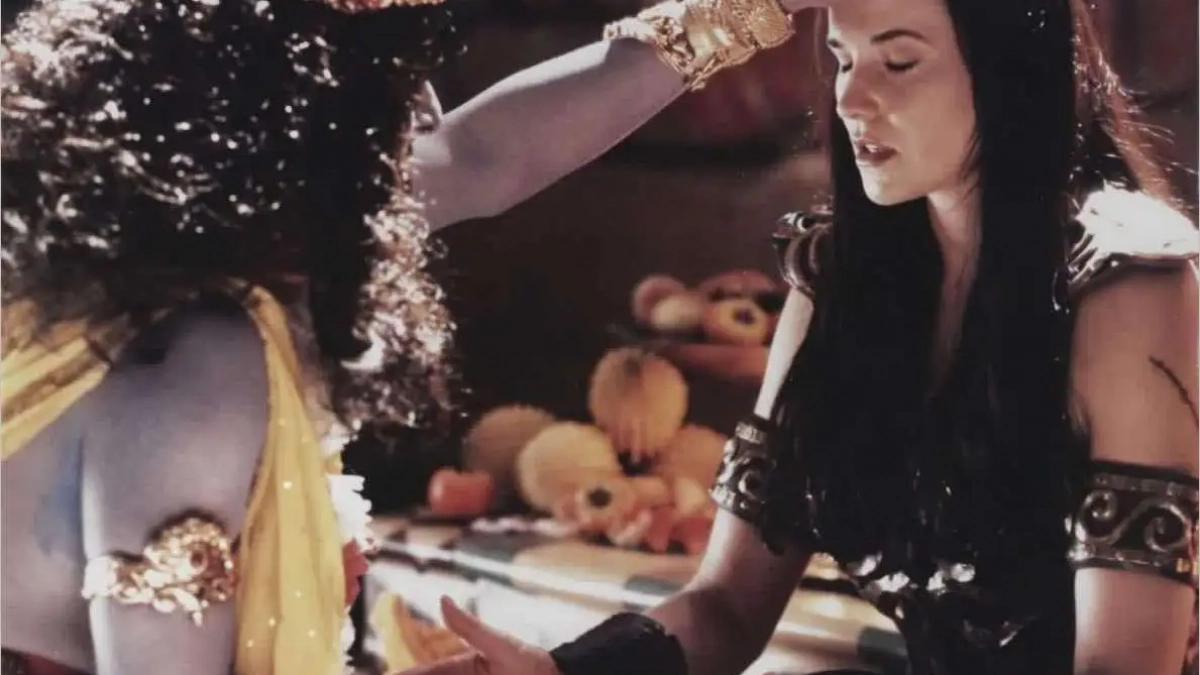
    Producers of the popular TV show, “Xena: Warrior Princess” have cast Krishna as a fictional supporting player in an upcoming action episode – “The Way”.

    The program, produced by Universal Studios, has Xena “seeking the help of the god Krishna to rescue Gabrielle and Eli from the clutches of the King of the Demons.”

    Hindus have voiced concern at this fictionalized portrayal of the revered Lord Shree Krisha. Our simple request to preview either the script of the episode or the episode itself, and evaluate it from the Hindu perspective has gone unanswered.

    We would like to express strong concerns about this episode on behalf of American Hindus Against Defamation (AHAD).

    We urge the Hindus around the world to write to the producers of the show, Universal Studios and the Pacific Renaissance Picture requesting that the Hindu concerns be fully addressed before this upcoming episode of Xena : The Warrior Princess is released.

    We would like to make the following points very clear :

    1. Irregardless of whether or not Bollywood also creates fictional scenarios about Lord Krishna, the point is that the way that it is apparently done here is in a way that equates Krishna with the gods of Greek and other mythology. It thus cheapens and trivializes what is inactuality something held sacred to almost one billion Hindus.

    2. Creating fictional role for Lord Krishna is akin to the creation of fictional role for Jesus Christ or Prophet Mohammed.

    3. Krishna is real! Krishna is the Supreme Lord, not a fictional,literary character who can be played with for mundane entertainment.

    4. Hindus will be deeply offended if the producers run this show.

    5. Many devotees will boycott products produced by the advertisers if the show is offensive to 1 billion strong Hindu community.

    5. Universal Studios will be perceived as anti-Hindu, if they proceed with the show.

    We certainly hope that the Universal Studios does not intend to hurt the sentiments of a billion strong Hindu community around the world. However, there is a distinct possibility that the airing of a story offensive to Hindus will indeed permanently alienate the Hindu community not just towards this particular show but all the entertainment products that Universal Studios produces. After all, Hindus around the world can hardly be silent spectators while the God they worship so passionately is being denigrated.

    It is our clear intention to avoid any confrontations or controversies. We have always sought to amicably resolve the issues that hurt the Hindu sentiments in the very early stage, and we are indeed hopeful that this issue will also be similarly resolved.

  • Letter from World Vaishnava Association: “Xena” World Vaishnava Association

    Letter from World Vaishnava Association: “Xena” World Vaishnava Association

    Letter to the producers of Xena from World Vaishnava Association

    India: 146 Gopesvara Road, Dist. Mathura UP Pin 281121
    United States: 3585 Red Dog Drive, Camino, CA 95709
    February 21, 1999

    Sue May
    Pacific Renaissance Pictures Ltd.
    P.O. Box 90409
    Auckland, New Zealand

    Re: Xena: Warrior Princess

    Dear Ms May

    Thank you for taking the time to speak with me this afternoon, in spite of the fact you were on the road.

    The World Vaishnava Association (WVA) is an umbrella organization comprised of more than 30 different independently functioning missions who are actively preaching the message of Lord Krishna as authorized in the Vedic scriptures. Member organzations are active not only in India, but in nearly 100 other countries around the world. The combined strength of WVA missions numbers in the millions and our teachings are respected and supported by a few hundred million Hindus of the non-Vaishnava tradition as well. Our rich spiritual heritage dates back some 5,000 years.

    During our conversation I expressed that Vaishnavas and Hindus are disturbed and alarmed by reports that Lord Krishna has been worked into the plot of next week’s episode of Xena: Warrior Princess, entitled “The Way.” Indeed I have already coordinated with Mr. Ajay Shah of the American Hindus Against Defamation, as well as three other Hindu and Vaishnava organizations.

    Lord Krishna is worshipped by several hundred million people around the world. He is the Supreme Lord and should never be manipulated by script writers and portrayed as a fictional character. Lord Krishna is not a fictional or mythical character any more than Lord Jesus Christ, The Prophet Muhammed or Allah are mythical. The overwhelming majority of Hindus and Vaishnavas will be extremely offended if they learn that Universal Studios has invented a story line for the Supreme Lord and then plugged Him into it.

    Even if Lord Krishna is portrayed in a “good” or favorable role, supporting the story’s heroine, it will still be offensive to his worshippers and devotees to see him speaking fictional words and engaging in fictional actions. Krishna is real. Krishna’s pastimes are real. It is insensitive and offensive to portray Lord Krishna either as a fictional character, or as engaged in fictional activities.

    I understand you are hesitant to reveal the plot of the upcoming episode. This is understandable. However, as a gesture of good faith, you should be more than willing to answer a few simple questions which will let us know whether Lord Krishna is being dealt with in a manner that is insensitive and offensive to his devotees:

    1. Are fictional words spoken by Krishna as part of the plot—words to do with the fantasy story, but which Krishna in truth never spoke?

    2. Does Krishna engage in fictional activities as part of the story line? If the answer to these questions is “yes”, then frankly speaking we have a problem.

    We understand you may not have understood the specific concerns outlined above when you undertook the production. However, the fact that Universal Studios and the producers of Xena and Hercules were specifically advised by a number of Hindu groups (inside and outside New Zealand) in September of 1997, about our concerns that Hindu deities be treated respectfully and sensitively on your productions is not lost on us. In light of this fact, we feel more than justified in asking you to not air this particular episode unless we are able to confirm that it treats Lord Krishna in a dignified and non-fictional manner. If you comply with our wishes we will not only be grateful, but there will certainly be no hard feelings for the fact that the feelings of pious Hindus and Vaishnavas were not considered prior to production, as requested in September, 1997. Indeed if the producers of Xena or Hercules ever wish to deal with Hindu deities in future episodes, we will be more than happy to provide complimentary consultation to ensure that you do so tastefully and in a manner not offensive to followers of Indian or Vedic religions.

    On the contrary if you choose to proceed with airing an episode that is offensive to Hindus and Vaishnavas, you can be assured there will be an organized international response. We don’t want this to happen. Indeed we would prefer to work with you and not against you. But this is not an issue that we take lightly.

    I look forward to your prompt response.

    Wishing you well,

    Shanti (Peace),
    Tusta Krishnadas
    Press Secretary

  • Harvard Crimson Article about AHAD Movement

    The Material Girl Goes Spiritual

    Those of you who missed the MTV Music Awards last week missed one of Madonna’s greatest moments. In winning five of the headline prizes, the Material Girl taught us two lessons: first, that some divas never die–they don’t even fade away. Second–and more importantly–she attempted to introduce many of us to a new cultural and religious tradition by blending into her live performance elements from the sacred (and profane) life of the Indian subcontinent.

    Madonna began her rendering of “Ray of Light” by chanting sacred mantras from the Vedas (the ancient Hindu scriptures) and incorporated into the performance steps derived from the traditional dance form native to the Indian region of Orissa. As American Hindus Against Defamation (AHAD) write on their website, the Hindu theme and use of Hindu symbols continued throughout the performance.

    It impresses me that one of the world’s most marketable celebrities would take the time to investigate the artistic traditions of another culture, develop an act around them and present them on the world’s stage.

    The problem is, what Madonna gave us isn’t Hindu (or Indian or even South Asian) culture. Instead she gave us ritualistic verses and dance steps ripped completely out of context. I admire Madonna and respect her efforts to expand our collective cultural experience. Unfortunately, by using her artistic license to syncretize Hindu and South Asian cultural elements with the Western performance culture, Madonna ran the risk of trivializing the faith of others. What began as a well-intentioned impulse to enrich our multicultural milieu backfired by alienating the very people whose traditions she was attempting to introduce to the general population.

    I should distinguish here between religious and cultural traditions. The latter are much more easily syncretized, with much less chance of causing insult or offense. South Asian culture is, in fact, an amalgam of all sorts of different constituent traditions. And Anglo-American culture has successfully managed to incorporate elements of South Asian culture in the past. The Beatles, for example, were influenced heavily by the music of the great sitar player, Ravi Shankar. We all know about the therapeutic powers of yoga–and, for better or worse, the teachings of Deepak Chopra. No Doubt’s Gwen Stefani is oft-seen wearing a bindi on her forehead; mehndi, the decorative paint worn by many Indian brides, has become quite popular among Western women. Even Nehru jackets may someday make a comeback.

    Religious traditions, however, require a bit more maturity and understanding to deal with. Pluralism and multiculturalism become trouble-some issues when we try simply to co-opt another religious tradition into our general popular culture without stopping to examine what that tradition actually means to its believers. That is why many Hindus found Madonna’s performance disturbing.

    It is the same reason why many Hindus took offense to the cover of Aerosmith’s Nine Lives, released in 1997. According to the on-line magazine India Pulse, “in place of Lord Krishna’s face Sony and Columbia artists inserted the head of a cat. They also altered the male chest of Lord Krishna to that of a female with breasts, wearing a woman’s blouse.” Media executives did not incorporate Hindu symbols out of love for the culture, or with a desire to educate; they simply were looking for something quaint and exotic to market better their product, with little regard for the sentiments of the people whose icons they were perverting. After receiving thousands of protest messages, the Sony higher-ups wisely decided to change the cover art in subsequent releases of the record.

    The Karma Club in Chicago (the sister nightclub of the one in Boston) also came under fire recently, for its interior decor. According to AHAD, this club features extravagant displays of religious icons in “compromising environments.” For example, pictures of the Hindu gods Shiva and Krishna occupy the wall of a bar, behind a number of bottles of liquor. A large statue of a dancing Shiva stands in the midst of the dance floor; a scantily clad man wearing a mask with three heads (apparently representing Lord Brahma) dances erotically on a pedestal. Finally, a statue of Lord Ganesha–the same deity that Hindus install at the entrance of their holy places–beckons people into the club.

    Clearly the images of the Hindu gods in the club are divorced completely from any religious connotation–they are mere commodities meant to add to its exotic flavor. Nothing could more trivialize the faith of Hindus. It is significant to note, perhaps, that the majority owner of the Karma Club is himself a Hindu of Asian Indian origin. My comments are thus directed not only to popular performers like Madonna and Aerosmith, but also to anyone heedlessly seeking to profit off the sentiments of others.

    The issue is not that Hindu religious symbols have been used inappropriately: Hinduism is one of the world’s most inclusive faiths, and its adherents certainly have no monopoly over the use of its symbols. But when these symbols are abused, and Hindu religious beliefs are trivialized, the trust and respect with which we must all treat one another in a liberal, multicultural democracy is violated.

    True religious understanding requires intense struggling with and rigorous study of the faith, something Madonna (and others) through their actions clearly have not bothered to undertake. Our multicultural society is weakened as a result, our sense of community diminished.

    Sujit Raman ’99-’00 is a history concentrator in Mather House. His column will appear on alternate Tuesdays.

  • Rallying religious revival

    An Early Article in India Today about HSC Traces the History of HinduNet and AHAD

    Title: Rallying religious revival
    Author: Arthur J. Pais (New York)
    Publication: India Today
    Date: November 15, 1997

    Kanchan Banerjee was prevented from performing Ganesh puja on the campus of
    Boston University nine years ago. He was stopped not by American rednecks
    or the KKK but the India Club-on the plea that the celebration of Diwali
    went against India’s secular constitution.

    It was probably similar complaints from fellow students at other American
    schools that led to the birth of the Hindu Students Council (HSC). The aim
    is unambiguous and untempered-to establish Hindu identify. “There are those
    who speak for Indian Americans or Canadian Americans. We speak for Hindu
    Americans and Hindu Canadians, and we want the younger generation to take
    pride in their Hindu roots-and challenge anyone, including their apathetic
    parents, who want to hide their Hindu identity.” says Banerjee, a national
    co-ordinator of the council.

    Since its inception in 1990. the HSC has grown dynamically. In November.
    the 50th branch is slated to open with three groups vying for the honour.
    Among the existing branches are those at elite universities like MIT,
    Harvard, University of Chicago. University of Michigan at Arm Arbor, the
    University of California at Berkeley, and Temple University. In addition.
    several high schools. including those at the nationally-acclaimed Phillips
    Academy in Andover. New Hampshire. are getting ready to open branches.

    “We have witnessed a dramatic growth in the last 18 months and now have
    13.000 members.” says San Diego-based Ajay Shah, who is in charge of the
    electronic services of HSC. There is no doubt that the council has grown in
    the last three years after it decided to go on its own following the
    centenary celebrations of Swami Vivekananda’s Chicago visit held in
    Washington D.C. by the Vishwa Hindu Parishad (VHP). attended by over 1
    0.000 people including 2.000 youths.

    Despite this, many of the its leaders still keep in close contact with the
    VHP. About six of them attended a VHP leadership conference held in New
    Hampshire last week. In addition, a dozen camps in different parts of the
    US and Canada have been organised where VHP leaders like Acharya Sushil
    Muni and Swami Dayananda Saraswati have addressed the gathering. The
    council counts among its staunch supporters Bhishm Agnihotri, the
    vice-chancellor of Southern Law School near New Orleans. and jurist Ved
    Nanda, Distinguished Professor at the University of Colorado in Denver.

    In a typical week, HSC holds prayer meetings. conducts study of scriptures
    and discussions on Indian history on more than 40 campuses. The HSC
    recently held a youth festival in Boston attended by more than 600 college
    and high school students, where every activity including a jeopardy-type
    pop quiz sought to reinforce the tenets of Hinduism.

    Writing letters to newspapers and news organisations to protest against
    what members feel is distorted presentation about India is one of the key
    activities carried out by the HSC. It is carried out through the Hindu
    Anti-Defamation League, part of the Hindu Universe
    (http://www.hindunet.org), the council’s home page on the Internet.
    Recently. members sent over three dozen letters to Reuters to protest
    against stories it carried about the Shivlinga. News reports on Kashmir
    receive constant criticism from the HSC for not mentioning the plight of
    Kashmiri pundits. “A few of these letters are published.” says Chandan
    Bhandopadhyaya, one of the leaders at Boston University. “But even when
    they are not, we hope we have raised some doubts in the minds of editors.”

    The Hindu Universe also has pictures of Hindu gods and goddesses. the
    legends that are attached to them, prayers. articles on Indian history, and
    a news update. Six HSC volunteers spend about 40 hours a week updating the
    material. “on an average day, there are about 5,000 hits. But when there
    is a political crisis or religious conflict, -we have seen more than 1
    0,000 hits in a single day.” says Shah. “Being students. and among the
    first ones to know about the cutting edge of technology, we were able to
    seize on cyberspace opportunities.”

    Religion is the primary. but not the only preoccupation of the group, It
    also organises social activities. Recently. members in three states
    adopted stretches of national highways. and spend ii few days in a month
    cleaning them. Several times a year, HSC groups join Americans in
    providing food to soup kitchens.

    Notably, a substantial number ofthe council’s members, are born and brought
    up in the US and probably that is why they are curious about their culture.
    Says Sheetal Patel, a New York high school student: “Often my American
    classmates would make fun of Indian traditions. about holy cows. about
    bindis and about the Shivlinga. And I could not talk to them in the idiom
    they understood. I believe I am going to learn a lot from HSC’s Hindu
    Universe and from attending the camps.”

    “HSC members seek to understand their religion. history and culture without
    stiffness and without being aggressive.” says Ralph Williams. professor of
    religion at the University of Michigan. Arm Arbor. But not everyone
    agrees. The council is often dubbed as a group of fundamentalists. The
    Indian Progressive Students Group (IPSG), a leftist group active on about
    two dozen campuses, lead the pack of those who think that the HSC is just
    another obscure Indian group. “They just don’t know enough about the VHP
    and the RSS and are letting themselves be subtly brainwashed.” says S.
    Sridhar, a former Columbia University student.

    Others too question the HSC brand of’ student activism. There is the
    underlying fear that the HSC could be controlled by the VHP-which could
    give a unidimensional view of Hinduism and India. “They say that they
    became independent of the VHP.” says S.P. Bose, a documentary filmmaker who
    graduated from the University of Southern Illinois. “I think it is a ploy.”

    Adds Chitra Banerjee Divakaruni. a novelist: “One is wary of student groups
    that have ties to political organisations and talk about religious issues.”
    The opposition to the group is bound to increase in coming years. Warns
    Raymond William. a scholar of Hinduism in Wabash. Indiana: “There could be
    a lot of challenges from fundamentalist Christian groups.”

    Ironically, the members of the Sangh Parivar are also not completely happy.
    “I would say the HSC has gained a full Hindu outlook when they abandon the
    current history books they are using,” says S. Venkat, an RSS activist. “I
    am surprised that they are using textbooks like The Wonder That Was India
    by A.L. Basham.”

    However. the members are not worried. “It helps us to be on our toes. and
    ready for any criticism.” says Shah.

  • Club Karma Defames Hindu Dharma

    Club Karma Defames Hindu Dharma

    Background Information / Press Release

    DRINKING, DANCING DEITIES: AN ATTACK ON HINDU DHARMA

    The latest trend in the Indian-American subculture is the rise of the Indian-theme bar and nightclub a place that combines Hindu deities and Indian art with the drinking of liquor, smoking, and dancing to the latest Western music. The American Hindu Anti-Defamation Coalition (AHADC) is shocked at this misuse of sacred Hindu symbols to promote nightclubs and alcohol-serving establishments.

    The latest club to follow this trend was opened in Chicago in early August by a partnership of two Indians and one American. This club features an extravagant display of religious icons in compromising environments: for example, pictures of Lord Shiva and Krishna intermixed with pictures of men and women in “sexy” outfits occupy the wall of a bar, behind a number of bottles of liquor. A giant Shiva Nataraja stands in the midst of a smoke-filled dance floor, the same symbol that is sacredly worshipped in temples and homes of Hindus everywhere. A man wearing a mask with three heads that appears to represent Lord Brahma is scantily clad and dancing erotically on a pedestal, seducing the patrons to this “exotic environment”. And a statue of Lord Ganesha beckons people into the club the same God that bestows an auspicious entrance to temples everywhere. The underlying theme here that is upsetting to many is the presence of symbols of holiness and purity within environments that are far less than holy and pure.

                                           AN EROTIC DANCER WITH 3 HEADS–IS THIS SUPPOSED TO BE OUR WISE LORD BRAHMA?

    Many Hindus and non-Hindus alike have frowned at what is seen as a sacrilegious attempt to profit from exoticism. A university student who wishes to remain anonymous, had this to say: “Placing icons in a club implies that it is okay to associate worldly pleasure with divine bliss. The Nataraj, Ganesh, etc. are aids to help one destroy, not strengthen, one s worldly attachments. This act tells me that these people are ignorant and blind of a true understanding of Hinduism.” A friend added, “This clearly shows that a Hindu s worst enemy is a Hindu. If we have no respect for ourselves, how do we expect others to respect our rich tradition?” One young non-Hindu businessman who attended the club on its opening night declared, “You would never go into a Western club and find people dancing around a statue of Christ. A Muslim would not think twice about placing any art in a club reflecting any ideal of Islam.”

    SHIVA NATARAJA STANDS TALL AMIDST A SMOKE-FILLED ROOM OF DANCING, DRINKING PEOPLE IGNORANT OF ITS HOLINESS.

    An overwhelming majority of those interviewed feel that the owners of this nightclub, named Karma, have gone too far by misrepresenting and exploiting Hindu culture and religion. Their sentiment is for all to take action against this act because “if we do not, we are passively accepting this denigration of our culture.” One of the owners, Srinivas “Sarin” Reddy, who spear-headed the formation of this club, could not be contacted by phone despite repeated attempts. There is also another Karma club in Boston which is raising similar conflict. Certainly, then, this issue is of concern to Indians and non-Indians everywhere. The American Hindu Anti-Defamation Coalition (AHADC) promises to take action against this club and urges all Hindu temples, organizations, and individuals to join its efforts in countering the trend of denigrating Hindu dharma for profits.

  • AHADC Efforts Leads to Sony Apology to Hindus : Offending CD Cover to Be Withdrawn Immediately

    The American Hindu Anti-Defamation Coalition (AHADC), is pleased to announce that on April 16, 1997, the senior lawyer for Sony Music & Entertainment, Inc., New York, (Sony), Mr. Joseph Salvo, contacted the attorney for AHADC, Mr. Chetan P. Tanna, and issued an apology on behalf of Sony/Columbia to the entire Hindu community for the offensive cover of the CD “Nine Lives” by a rock group, Aerosmith.

    The cover of the CD “Nine Lives” portrayed a distorted and offensive picture of Hindu God, Shree Krishna, which infuriated thousands of Hindus around the world. Over 10 Hindu organizations, representing thousands of Hindus had joined the AHADC in its protest against the Sony/Columbia/Aerosmith trio.

    The AHADC had set up a protest site,

    which was visited by about 10,000 people in two weeks, and over 1,400 persons signed individual on-line protest letters to SONY, Columbia and Aerosmith, and several stores selling this CD.

    Sony’s senior counsel said, “Sony could not ignore thousands of messages from the Hindus around the world, and had decided to immediately stop the production of said CD.

    AHADC and SONY Corporation, have verbally agreed that :

    1. As of today, SONY will stop manufacturing the CD, until the cover is changed.

    2. SONY will try to recall the CDs from the market as much as possible.

    3. SONY will provide the AHADC with the new cover for AHADC’s approval before publication. SONY will not use any Hindu religious symbols in any form.

    4. SONY will issue a public apology to the Hindus in the Hindu/India related publications, in the U.S., as well as in India, and also on the SONY website called SonyOnLine. (www.music.sony.com.)

    The AHADC appreciates SONY’s decision in response to the protest by the Hindu community around the world. The AHADC would especially like to thank Blockbuster Music for assuring us earlier that they will not sell the CD, unless the offensive cover was changed.

    The AHADC believes that SONY’s actions are the due to the unity, determination and hard work by the Hindu community. We thank the Hindu organizations, who joined the AHADC, and all individuals who signed the online protest and/or sent e-mail and letters to SONY/Columbia/Aerosmith and to the stores selling this CD. A notable aspect of this protest movement was that we received support also from our non-Hindu friends
    and well-wishers!

    The AHADC was convened by VHP of America (World Hindu Council of America), represented by Ajay Shah, Chetan P. Tanna, Vaani Chawla, and Rajiv Dutta