Category: CA_SB-509

  • ACT: Sign Petition Against SB-509

    ACT: Sign Petition Against SB-509

  • Legal Brief Opposing SB-509

    1. INTRODUCTION

    This legal brief contests the constitutionality and detrimental socio-political ramifications of California Senate Bill 509 (“SB-509”), which has been enacted under the guise of addressing transnational repression. Notwithstanding its declared purpose, SB-509 poses a substantial risk of evolving into a legislative instrument for selective profiling, cultural suppression, and the violation of constitutional rights of law-abiding Indian-American and, specifically, American Hindu communities in California.

    The legislation, which has been poorly drafted and vigorously promoted by interest groups with specific agendas, establishes pathways for the government to scrutinize legitimate cultural, religious, and political expressions under the pretense of thwarting foreign interference.

    1. STATEMENT OF FACTS
    • Purpose of SB-509:
      SB-509 purports to criminalize acts of transnational repression, which are defined as attempts by foreign governments to harass or silence diaspora communities.
    • Concerns Regarding Targeting:
      India and its diaspora, especially American Hindus, have been disproportionately referenced in public campaigns advocating for SB-509, notwithstanding the global nature of diaspora politics.
    • Community Alarm:
      American Hindu civic and cultural organizations, which are actively involved in legitimate advocacy and the promotion of cultural heritage, are facing an escalated risk of unwarranted scrutiny.
    • HinduPACT Statement:
      “SB-509 is dangerously overbroad and poses a risk of criminalizing the lawful activities of members of our community. By neglecting to differentiate between authentic harassment and legitimate cultural or political advocacy, this legislation paves the way for the profiling of Indian-Americans and Hindu organizations based on unfounded suspicions. We strongly urge the State of California to reject this bill in order to safeguard our constitutional freedoms.”
      — HinduPACT (Hindu Policy Research and Advocacy Collective)

    III. LEGAL ISSUES

    1. First Amendment Violations
      • Encroachment upon the rights of free speech, religious expression, and freedom of association.
    2. Fourteenth Amendment Equal Protection
      • Selective enforcement poses the risk of disproportionately targeting Indian-American and Hindu communities.
    3. Vagueness and Overbreadth
      • Ambiguities present unconstitutional risks related to arbitrary enforcement.
    4. Conflict with International Human Rights Norms
      • Cultural rights and protections for diaspora communities are jeopardized.
    1. ARGUMENTS
    2. SB-509 Imperils Free Speech and Religious Freedom

    The First Amendment protects community advocacy, cultural events, and political expressions. SB-509’s imprecise language could criminalize lawful community activities simply because they reflect cultural or political pride connected to India.

    1. Violates Equal Protection Under the Fourteenth Amendment

    The inequitable targeting of activism pertaining to India fosters an atmosphere of selective enforcement, which is inconsistent with the constitutional guarantees of equal protection.

    1. Law Is Impermissibly Vague

    The failure of the bill to precisely delineate the terms “intimidation” or “coercion” exposes ordinary civic actions to potential arbitrary interpretation and enforcement.

    1. Contradicts International Human Rights Commitments

    The right of minority communities to cultural expression is enshrined in international law. SB-509 threatens these rights for Indian-Americans.

    1. CONCLUSION

    SB-509, while styled as protective legislation, threatens to violate constitutional protections and promote cultural profiling. It risks chilling legitimate speech, undermining civic participation, and fostering unjustified suspicion toward Hindu-American and Indian-American communities.

    Recommendations:

    • Urgent legislative amendment to clarify and narrowly tailor the bill.
    • Development of enforcement protocols that prohibit cultural and religious profiling.
    • Vigilant judicial oversight and, if necessary, constitutional challenge.

    Respectfully submitted,
    [HinduPACT Legal Advocacy Team]
    April 2025

  • SB-509 FAQ

    What is California SB-509?

    SB-509 is a bill designed to address transnational repression by providing specialized training to law enforcement in California. It aims to protect communities from intimidation or harassment by foreign governments or entities.

    Why oppose SB-509 if it aims to protect communities?

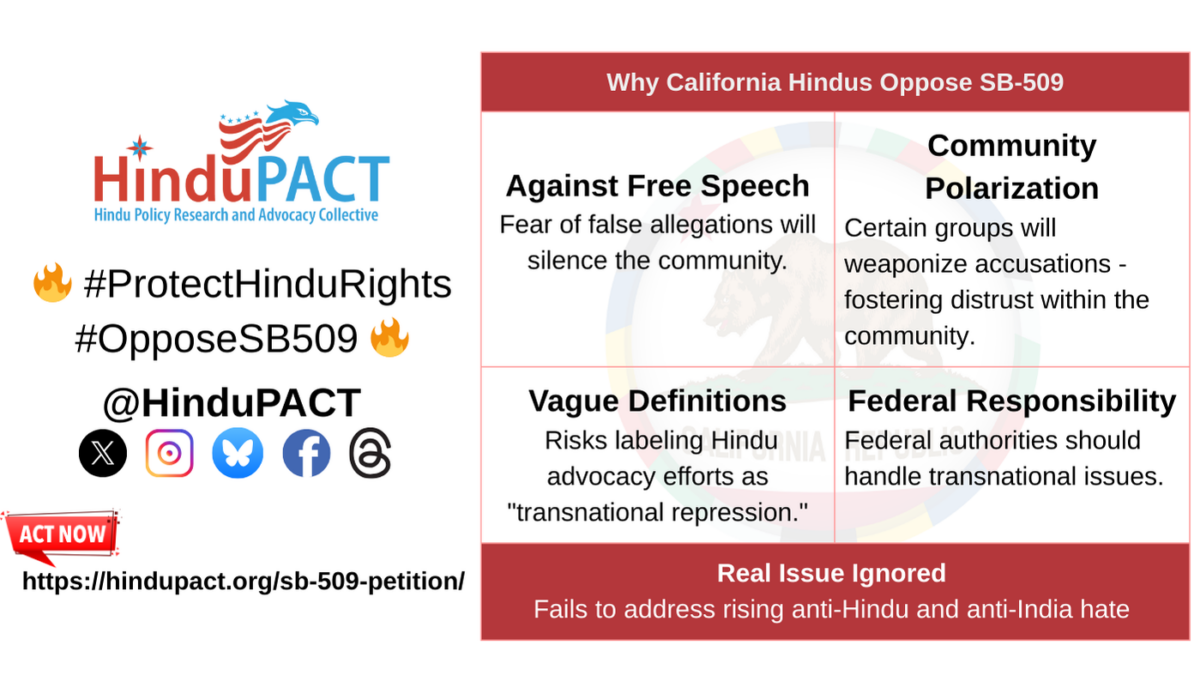
    While the intention may be positive, the bill’s vague definitions and broad scope create risks of misuse against specific communities, such as Indian-American and American-Hindu groups, potentially targeting legitimate advocacy activities as forms of repression.

    How could SB-509 specifically affect Hindu communities?

    SB-509 could empower groups such as Khalistani activists to falsely accuse Hindu individuals and organizations of engaging in transnational repression. This could result in increased scrutiny, reputational harm, and a chilling effect on community advocacy.

    Could SB-509 increase polarization within communities?

    Yes. SB-509 could amplify tensions by enabling certain groups to weaponize accusations, thus fostering distrust and division within diverse communities, particularly between Hindu and Sikh groups.

    Is there a risk of selective enforcement under SB-509?

    Yes. Given its ambiguity, SB-509 could be selectively enforced, disproportionately targeting Indian-origin and Hindu communities based on political narratives rather than genuine security threats.

    Can SB-509 negatively impact free speech?

    Yes. Fear of false allegations could significantly deter individuals and groups from openly expressing legitimate concerns regarding geopolitical or cultural issues, thus limiting free speech and advocacy.

    What steps can individuals take to oppose SB-509?

    Individuals can contact their local representatives, participate in community advocacy meetings, raise awareness through social media, join coalitions opposing SB-509, and testify at legislative hearings.

    Are other community groups opposing SB-509?

    While official documented opposition is still developing, various communities have expressed concern over potential misuse and selective targeting under SB-509, especially those engaged in international advocacy.

    Does SB-509 address genuine issues of repression adequately?

    While the intention behind SB-509 addresses legitimate concerns of foreign intimidation, its broad language fails to adequately differentiate between genuine repression and legitimate community advocacy, creating unintended negative impacts.

  • HinduPACT’s Formal Letter of Opposition to SB-509

    On behalf of California’s Hindu and Indian-origin communities, we strongly urge you to reject Senate Bill 509 (SB-509). At the same time, we acknowledge the bill’s stated goal of addressing transnational repression, its unintended consequences, vagueness, and potential for misuse, which present serious threats to our communities. Additionally, such issues clearly fall under federal jurisdiction, not state legislation.

    Key Reasons to Fully Reject SB-509:

    Federal Jurisdiction and Usurpation of U.S. Foreign Policy

    Transnational repression and foreign policy are issues best managed by federal authorities. SB-509 risks infringing on federal responsibilities, which could disrupt diplomatic relations between the United States and key global partners such as India. Individual states should refrain from legislating on international affairs, as this creates conflicting standards and undermines the federal government’s capacity to manage diplomatic relations effectively.

    Economic Risks to California

    California’s economic prosperity is closely linked to international trade, especially with India—a significant global economic partner. SB-509 could adversely affect trade and investment flows, leading to uncertainty and deterring international collaboration. The economic consequences could involve the loss of business partnerships, decreased foreign investment, and slowed economic growth.

    Ambiguous Definitions Leading to Misuse

    SB-509 includes broad and vague language, making it susceptible to exploitation by politically motivated groups. Anti-India or separatist factions, such as Khalistani activists, might misuse the bill to incorrectly label legitimate activities of the Hindu or Indian-American community as transnational repression. This exploitation can lead to unjust investigations, surveillance, and legal actions against innocent community leaders and organizations.

    Rising Documented Hinduphobia and Anti-Hindu Hate Crimes

    California’s Hindu community is encountering rising levels of discrimination and targeted attacks:
    – According to the California Civil Rights Department’s ‘CA vs Hate’ hotline (2023), 23.3% of reported religious hate incidents targeted Hindus.
    – In 2023 alone, six Hindu temples in the Bay Area experienced acts of vandalism, including hateful graffiti that was explicitly anti-Hindu and anti-India.
    – Gandhi statues in Davis (2021) and multiple other locations have been desecrated, highlighting a concerning rise in targeted hostility against symbols of Hindu and Indian heritage.

    Specific Risks to Hindu Communities

    Hindu Californians may encounter heightened harassment under SB-509, particularly from Khalistani activists who have a history of using threats and misinformation against Hindu temples and community groups. This misuse could wrongly stigmatize Hindu organizations, hinder legitimate advocacy efforts, and harm community relations. The bill could unintentionally empower extremists, allowing them to intimidate and silence genuine Hindu voices.

    Exacerbation of Community Tensions

    SB-509 has the potential to amplify existing divisions within California’s diverse communities. Misapplication of its provisions could increase polarization, particularly between Hindu and Sikh populations, negatively impacting community cohesion and mutual understanding.

    Given these substantial risks and the inherent federal jurisdiction over international matters, we strongly urge the complete rejection of SB-509. Our communities support effective federal initiatives against genuine repression but oppose state-level legislation susceptible to severe misuse and unintended consequences.

    Thank you for your thoughtful consideration.

    Sincerely,

    Deepti Mahajan
    Co-Convenor
    HinduPACT

    March 23, 2025

  • Regardless of Faith, Indian-Origin Californians Should Oppose SB-509

    1. Potential for Selective Enforcement:

    • SB 509 could unintentionally target or disproportionately impact specific diaspora groups, including Indian-origin communities, due to geopolitical tensions between India and advocacy groups in the U.S.
    • Indian Americans may worry that legitimate activities—such as advocacy, criticism of anti-India groups, or support for India’s territorial integrity—could be mischaracterized as acts of “transnational repression.”

    2. Misuse by Anti-India Advocacy Groups:

    • Organizations hostile to India could exploit provisions of the bill by labeling legitimate advocacy by Indian diaspora groups as forms of “transnational repression,” thus chilling legitimate community activism.
    • This could particularly affect Hindu-American or pro-India advocacy groups, potentially resulting in increased scrutiny or bias against them.

    3. Ambiguity and Subjectivity in Definitions:

    • The bill’s broad language regarding “intimidation” or “harassment” could be subjectively interpreted, opening possibilities for misuse or politicization against Indian diaspora groups involved in civic engagement.
    • The absence of clearly defined thresholds could inadvertently categorize passionate political or cultural debates as repressive actions.

    4. Impact on Community Relations and Dialogue:

    • There could be concerns that SB 509 may deepen existing divisions within the Indian community, fueling suspicions between diaspora groups advocating different perspectives on Indian policies.
    • The bill may inadvertently suppress dialogue and free speech among Indian-American community members concerned about India’s geopolitical or security interests.

    5. Foreign Policy and Sovereignty Concerns:

    • Some Indian-Americans may perceive the bill as an indirect interference in India’s internal affairs, validating claims made by advocacy groups critical of India’s government and thus affecting bilateral relations between the U.S. and India.
    • An issue could exist over whether local U.S. jurisdictions (like California) should handle complex geopolitical issues usually managed at the federal level.
  • Why California Hindus Must Reject SB-509

    1. Increased Risk of False Allegations:

    • Khalistani groups, seeking to suppress pro-India or Hindu perspectives, could leverage SB-509 to portray Hindu or pro-India advocacy as “transnational repression,” accusing individuals or organizations of acting on behalf of India’s government.
    • This could lead to wrongful investigations or harassment of Hindus who publicly oppose Khalistani separatism.

    2. Chilling Effect on Hindu Advocacy:

    • Fear of being accused under SB-509 could discourage Hindus from openly challenging Khalistani narratives, speaking out against separatism, or organizing pro-India cultural events, effectively silencing important community dialogue.

    3. Stigmatization of Hindu Organizations:

    • Khalistani activists could weaponize SB-509 provisions to stigmatize Hindu temples, community organizations, or advocacy groups by labeling their legitimate pro-India activities as state-sponsored “transnational repression.”
    • This could negatively impact community cohesion and trust, potentially leading to social isolation or reputational harm for Hindu groups.

    4. Increased Polarization and Tension:

    • Khalistani groups might exploit SB-509 to amplify their claims of victimization, indirectly suggesting Hindu communities in California are complicit in repression or harassment.
    • This portrayal could exacerbate communal tensions and polarization between Hindus and Sikh communities, harming inter-community relations.

    5. Disproportionate Scrutiny and Surveillance:

    • California Hindus who vocally oppose Khalistani separatism might face increased scrutiny, law enforcement interventions, or surveillance stemming from accusations made under SB-509’s framework.
    • Even unfounded claims could lead to intrusive investigations, significantly affecting personal security, privacy, and civil liberties of Hindu activists or leaders.

    Therefore, while SB-509 seeks to tackle the threats of transnational repression, its wide-ranging scope and unclear definitions will enable Khalistani groups to exploit its provisions, disproportionately affecting California Hindus through legal harassment, reputational damage, and community division.